Syrian President’s White House visit marks key diplomatic moment
Trump to welcome Syrian leader al-Sharaa amid global focus on Middle East diplomacy
For the first time in history, a Syrian president will visit the White House. US President Donald Trump is set to host Syrian President Ahmad al-Sharaa in Washington, likely on November 10, 2025, according to an official statement released on Saturday. The meeting is seen as a major diplomatic step for both nations after decades of tension and conflict in the Middle East.
A meeting after decades
The upcoming visit marks a historic moment — the first meeting between American and Syrian leaders in nearly 25 years. The last such meeting took place in 2000, when then-Syrian President Hafez Assad met US President Bill Clinton in Geneva. Relations between the two countries had since remained frozen due to Syria’s long-standing isolation and its involvement in regional conflicts.
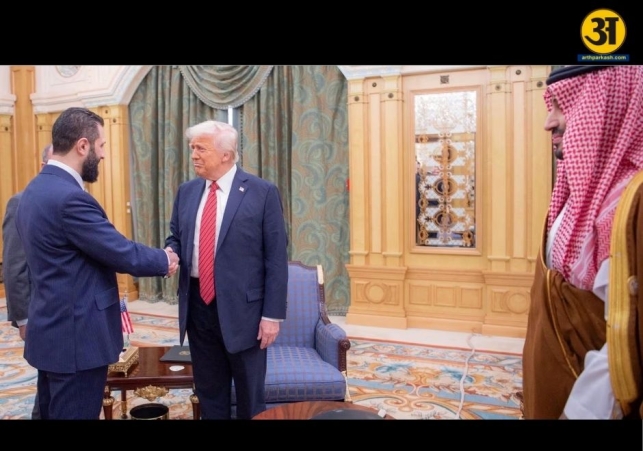
President Trump and Ahmad al-Sharaa first met in May 2025 in Saudi Arabia, during a regional summit in Riyadh. That meeting laid the groundwork for future talks and was seen as a symbolic thaw in US-Syria relations. The White House invitation that followed shows a shift in Washington’s approach towards Damascus — from treating it as a threat to seeing it as a potential ally in the fight against terrorism.
The announcement of the visit comes shortly after al-Sharaa addressed the United Nations General Assembly (UNGA) in New York in September. His speech at the UN marked Syria’s return to the global diplomatic stage after years of isolation.
Who is Ahmad al-Sharaa?
Ahmad al-Sharaa, aged 43, is one of the most controversial leaders in modern Syrian history. He became Syria’s president in early 2025 after the fall of the Bashar al-Assad regime. Born in Saudi Arabia, al-Sharaa had a complex and violent past before entering mainstream politics.
In the early 2000s, al-Sharaa fought for al-Qaeda in Iraq during the US-led invasion. Between 2003 and 2006, he participated in the Iraqi insurgency but was captured by American troops in 2006. The US held him in custody until 2011, labeling him a dangerous militant. At one point, Washington even announced a USD 10 million bounty for his capture due to his terror links.
However, after his release, al-Sharaa turned against the Assad government and became a leading figure in the Syrian civil war. In 2012, he helped create the al-Nusra Front, a rebel group backed by al-Qaeda, to fight Assad’s forces. But by 2016, he distanced himself from al-Qaeda to gain legitimacy in the eyes of the international community.
From 2017 to early 2025, al-Sharaa served as the emir of Hay’at Tahrir al-Sham (HTS), a Sunni political and military organization. The group later evolved into a nationalist movement against Assad’s dictatorship. When Bashar al-Assad fled to Russia in December 2024, al-Sharaa rose to power with strong support from the United States, signaling a major realignment in the war-torn nation.
ALSO READ: Indian forces showcase integrated war readiness in massive Trishul exercise
ALSO READ: Good fat, bad fame: Doctor debunks six biggest myths about cholesterol
Focus on fighting ISIS
One of the most critical aspects of al-Sharaa’s visit will be a potential agreement for Syria to join the US-led coalition against ISIS (Islamic State of Iraq and Syria). If signed, this would represent a dramatic change in Syria’s role in the region — from being a battlefield for global powers to becoming an active partner in counterterrorism operations.
Tom Barrack, the US Special Envoy to Syria, said Washington has been trying since 2014 to bring Syria into its anti-ISIS alliance. The group, which once controlled vast areas of Iraq and Syria, was largely defeated but is now trying to regroup in Syrian territory after the collapse of the Assad government.
“We are trying to get everybody to be a partner in this alliance, which is huge for them,” Barrack told reporters, hinting at the importance of Syria’s cooperation.
Currently, Syria remains the last major stronghold of ISIS, making its inclusion in the coalition strategically vital. Analysts believe that a formal agreement during the White House visit could help stabilize parts of the Middle East and limit ISIS’s attempts to rebuild its network.
Talks on regional peace
Besides counterterrorism, the meeting is also expected to include discussions on de-escalation between Syria and Israel. The United States has been quietly mediating between the two nations, hoping to reduce tensions and encourage a peace framework.
Officials familiar with the negotiations said that Syria and Israel are close to reaching a preliminary understanding. If successful, this could open the door for further peace talks and even diplomatic recognition between the two countries — something that once seemed impossible.
Trump’s administration has been focusing on reshaping Middle Eastern alliances since 2024. Bringing Syria — once labeled a “rogue state” — into dialogue with Israel and the West could mark a major diplomatic victory for Washington.
For Syria, the visit offers a rare opportunity to re-enter the global community after years of civil war, sanctions, and isolation. It also gives al-Sharaa a platform to present himself not as a former militant, but as a legitimate head of state seeking international cooperation.
A symbolic and strategic moment
This meeting is more than just a diplomatic gesture. It symbolizes a new chapter in US-Syria relations, one that could influence the region’s political and security landscape. While critics remain wary of al-Sharaa’s past ties to extremist groups, the US sees this engagement as a chance to steer Syria toward stability under American influence.
If Syria indeed joins the anti-ISIS coalition and improves relations with Israel, the November 10 visit could go down as one of the most significant turning points in Middle Eastern diplomacy in recent years.
For now, the world will be watching Washington closely as President Trump and Ahmad al-Sharaa make history at the White House — an event that could redefine old rivalries and reshape alliances in the ever-complex politics of the Middle East.
Related News